
TriSim: Tri-Dimensional Similarity Modeling with Extreme Value Theory for False-Negative Mitigation in Remote Sensing Image-Text Retrieval
Three-way similarity modeling for reliable remote-sensing retrieval
Proceedings of the IEEE/CVF Conference on Computer Vision and Pattern Recognition, 2026
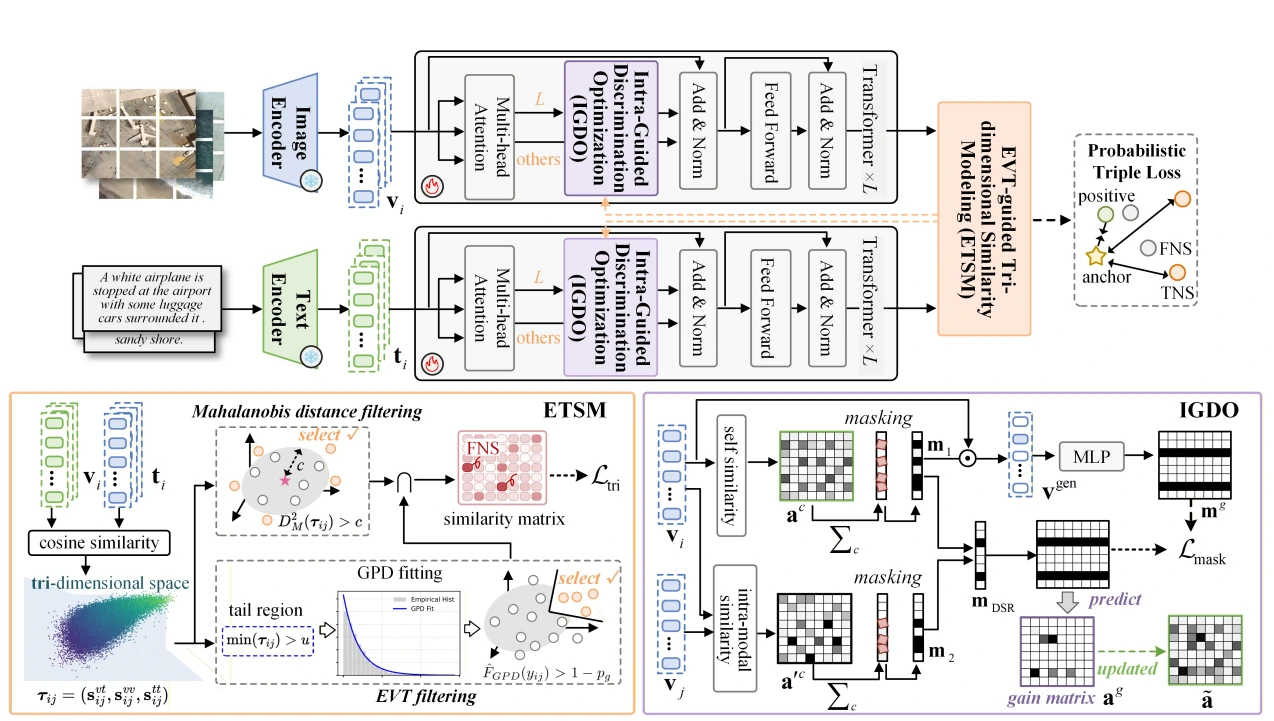
TriSim method overview supplied by the project author.
I. Core Problem and Overall Significance
Research Background
Remote Sensing Image-Text Retrieval (RSITR) aims to align geospatial imagery with textual descriptions in a shared embedding space, enabling bidirectional retrieval. Most modern RSITR systems rely on contrastive learning, minimizing anchor–positive distances while pushing negatives apart. However, remote sensing data are characterized by high intra-class visual/semantic similarity, scattered backgrounds, and large-scale variations, which make the negative-sample definition fragile.
Problem Addressed
The paper targets false negative samples (FNS): negative pairs that are semantically related despite being labeled as mismatched. Contrastive objectives unintentionally repel such pairs, degrading the learned semantic space.
Why It Matters
In RS data, images of similar land-cover types, objects, or scenes frequently co-occur with semantically overlapping captions. If FNS are not handled, the model learns inconsistent representations and retrieval performance suffers. Correctly identifying and down-weighting FNS is therefore a core issue for accurate RSITR.
Limitations of Existing Approaches
- Existing methods usually set a threshold on cross-modal image–text similarity; negatives with similarity above the threshold are treated as FNS and discarded or softly down-weighted.
- This single-modality-pair threshold is fragile for two reasons:
- Cross-modal semantic overlap: unrelated pairs that share partial semantics can have high image–text similarity and be wrongly discarded.
- Cross-modal semantic gaps: truly matched pairs can exhibit low image–text similarity (due to modality misalignment) and be wrongly retained as true negatives.
- The authors argue that exclusively cross-modal scoring ignores strong intra-modal correlations (image–image and text–text) that underlie elevated cross-modal similarity.
II. Methodology
Core Idea
Instead of relying on cross-modal similarity alone, TriSim builds a tri-dimensional (3D) similarity space for each candidate negative pair:
where is normalized cross-modal image–text similarity, and are intra-modal image–image and text–text similarities. FNS are treated as anomalies in this 3D space, which reduces the risk of misclassification caused by cross-modal semantic overlap/misalignment.
Key Modules and Design
1. EVT-Guided Tri-Dimensional Similarity Modeling (ETSM)
Two complementary statistical filters are applied to the 3D triplets:
-
Mahalanobis Distance Filtering (A)
Computes the squared Mahalanobis distance of each triplet from the multivariate mean. Since it follows a chi-squared distribution with 3 degrees of freedom, a significance-level threshold yields a set of samples lying far from the dense ellipsoidal center. This captures peripheral outliers. -
Extreme Value Theory Filtering (B)
Selects triplets whose minimum of the three similarity components exceeds a high quantile (i.e., upper-right high-similarity extremes). The excesses are modeled with the Generalized Pareto Distribution (GPD) whose scale/shape parameters are estimated by maximum likelihood. The fitted CDF gives a probability for each candidate; pairs with form . -
Unified FNS set
The final FNS set is , combining both tail-detection strategies. -
Probabilistic Triplet Loss
For each negative pair, a discard probability is assigned: 0 for non-FNS; for FNS it is . A Bernoulli indicator is sampled, and the triplet loss uses to drop or down-weight FNS. The total loss is the average of image-to-text and text-to-image triplet losses with margin .
2. Intra-Modal Guided Discrimination Optimization (IGDO)
This module refines features of the selected FNS by amplifying discriminative regions and suppressing ambiguous ones.
-
Saliency-based mask construction
For an FNS pair and the true positive image of , self-attention similarities and are computed. Column-summed saliency vectors and identify patches that are salient in itself but not salient relative to . A mask encodes these discriminative patches. -
Trainable gain matrix
Instead of directly using the mask, a lightweight MLP maps the masked features to a predicted mask , supervised by via L2 loss. The predicted mask guides a gain matrix , which is added to the original self-similarity matrix: . The refined matrix is used in the final Transformer layer, with a final loss term weighted by .
How the Components Work Together
- The ETSM identifies probable FNS in a statistically grounded way across the whole batch.
- The probabilistic triplet loss softly filters these FNS during contrastive optimization.
- The IGDO then helps the model exploit the identified FNS by directing attention to their truly discriminative, idio-syncratic features — regions that are unique to the specific image rather than generic category cues.
- Together they provide both a global sample-selection mechanism and a local feature-refinement mechanism, targeting the FNS problem from two levels.
III. Experimental Design
Datasets
- RSICD: 10,921 satellite images (≥224×224 pixels), each with 5 reference sentences.
- RSITMD: ~4,000 high-resolution image–text pairs (typically 256×256), covering diverse urban/natural scenes, also with 5 sentences per image.
Tasks and Metrics
- Two retrieval tasks: image-to-text (I→T) and text-to-image (T→I).
- Metrics: Recall@K for K ∈ {1, 5, 10} for each direction, plus mean recall (mR) averaged over all six reported recall values.
Baselines
Twenty-five methods are compared, grouped into:
- General retrieval networks: SCAN, CAMP, MTFN, SGRAF, NAAF.
- Remote-sensing-specific methods: SAM, LW-MCR, GaLR, IEFT, PIR, HVSA, DOVE, SWAN, CFITR.
- CLIP-based variants: CLIP, CLIP-Adapter, VPT, CoCoOp, MaPLE, CLGSA, RemoteCLIP, CUP, TDUF, GLISA, AIR.
Implementation Details
- Backbone: pretrained RemoteCLIP for image/text feature extraction.
- Transformer layers ; optimizer Adam with initial learning rate and decay 0.7; batch size 700.
- Two-stage hyperparameters for ETSM: first stage , , ; second stage quantile, , .
Qualitative / Case Studies
- FNS detection strategy visualization: illustrates that Mahalanobis filtering captures peripheral outliers, EVT filtering captures upper-right extremes, and the union/intersection covers the tail more comprehensively.
- Comparison of sampled FNS: shows that threshold-based FNE tends to select only high cross-modal-similarity points, while TriSim identifies a related pair with low cross-modal similarity as FNS (due to intra-modal cues) and rejects an unrelated pair with high cross-modal similarity as a true negative.
- Mask visualization: highlights regions in v_i emphasized by the learned gain mask that are not salient in the true positive v_j, confirming the intended discriminative-region effect.
- Retrieval demos: show top-3 image/text retrieval results; most are correct, some are semantically related but not exact matches.
IV. Resources and Compute
The paper explicitly reports only that all experiments were conducted on an NVIDIA RTX A6000 GPU.
The paper does not explicitly report this information: total GPU count, training time, inference cost, model parameter count, FLOPs, or memory usage.
V. Experimental Coverage and Sufficiency
Groups of Experiments
- Main comparison against 25 methods on two benchmarks (RSICD and RSITMD).
- Quantitative visual analyses:
- Effects of the FNS detection strategies.
- Comparison of sampled FNS between threshold-based filtering and TriSim’s 3D method.
- Visualization of regions emphasized by the gain-matrix mask.
- Retrieval demos.
- Ablation studies on RSITMD:
- Full model vs. no IGDO vs. no modules at all (Table 2).
- FNS detection strategy: CT (cross-modal threshold), AT (3D space with quadrant-wise thresholds), and A+B (proposed Mahalanobis + EVT) (Table 3).
- Hyperparameter evaluation for , , and , measured both before and after the final Transformer layer.
Coverage
- Datasets/settings: Two public RSITR benchmarks with consistent annotations.
- Ablations: Present and informative; the removal of ETSM (i.e., baseline) causes a clear drop (mR 47.96 → 49.86 with only ETSM; full model 51.35).
- Sensitivity analysis: Provided for the three main ETSM hyperparameters.
- Missing: No efficiency/compute-time study, no cross-dataset generalization test, no statistical significance testing.
Does the Evidence Support the Claims?
Yes, for the central claims that (a) 3D similarity modeling improves FNS identification over cross-modal-only thresholds, and (b) intra-modal saliency-guided refinement helps. The ablations and quantitative Table 3 directly support these points.
However, the main comparison fairness cannot be fully verified from the paper alone: it is not stated whether all baselines were re-trained under identical backbones, schedules, and hyperparameters, or whether results were borrowed from prior publications.
VI. Main Conclusions and Findings
Quantitative Results
- RSICD: TriSim achieves the highest mean recall mR = 37.55 (e.g., GLISA: 36.99, AIR: 36.24), with the best T→I recalls: R@1 = 15.99, R@5 = 40.19, R@10 = 57.69. For I→T, it reaches R@10 = 53.26 but not the best R@1/R@5.
- RSITMD: TriSim achieves the best mR = 51.35, outperforming the strongest prior method AIR (50.22) by a clear margin. It is particularly strong in text retrieval: T→I R@1 = 26.95, R@5 = 61.86, R@10 = 78.58. Image retrieval improvements are more modest (I→T R@1 and R@5 are below AIR).
- The paper reports improvements over leading methods of 1.51% on RSICD and 2.25% on RSITMD; these appear to be relative improvements over the best prior mR values, while the absolute mR gaps are +0.56 and +1.13 respectively.
Ablation Findings
- Removing both proposed modules drops mR to 47.96 (RSITMD); adding only the ETSM module raises it to 49.86; the full model reaches 51.35.
- The proposed tail-detection strategy (51.35 mR) outperforms both a simple cross-modal threshold (: 48.54) and a 3D threshold-per-quadrant variant (: 49.16).
Supporting Qualitative Findings
- The 3D space correctly labels a low-cross-modal-similarity pair as FNS when intra-modal relations indicate semantic relatedness, and labels a high-cross-modal-similarity pair as a true negative when intra-modal relations do not corroborate the match.
- The learned gain-matrix mask highlights image-specific discriminative regions rather than generic category-salient regions.
VII. Strengths
- Novel problem formulation: First framework to model FNS detection in RSITR through a tri-dimensional similarity space rather than a single cross-modal score.
- Statistical rigor: The combination of Mahalanobis distance (chi-squared testing) and EVT/GPD tail modeling is a principled, non-arbitrary way to select extreme samples; it directly addresses the “threshold fragility” criticism.
- Two-level mitigation: FNS are handled both at the sample-selection/loss level (ETSM + Bernoulli probabilistic triple loss) and at the feature-refinement level (IGDO).
- Strong empirical breadth: 25 baselines across multiple families (general, RS-specific, CLIP-based); consistent gains in mean recall on two benchmarks.
- Thorough ablations and hyperparameter analysis: The design choices are individually validated, and the major hyperparameters are swept.
- Interpretability: Qualitative visualizations convincingly illustrate why threshold-based selection fails and how the 3D space behaves.
VIII. Limitations
Limitations Stated or Acknowledged in the Paper
- The authors note that improvements on the image retrieval task on RSITMD are comparatively modest; they attribute this to limited diversity in textual descriptions, which increases the likelihood of false negatives.
- The retrieval demos show that some results are incorrect, although the paper says such outputs remain highly relevant and “generally acceptable.”
Limitations Inferred from the Method and Experiments (Not Explicitly Stated by the Authors)
- Hyperparameter sensitivity: The method relies on several user-set thresholds (, , , , plus loss weights , , and boundary thresholds , ). While the paper sweeps some of them, the need for stage-specific tuning suggests sensitivity across datasets/backbones.
- Backbone dependence: The entire pipeline is built on a pretrained RemoteCLIP backbone; it is unclear whether the gains transfer to weaker or stronger encoders.
- Limited generalization evidence: Experiments cover only two mid-sized RS datasets; no large-scale datasets (e.g., RS5M), no cross-dataset transfer tests, and no noisy-correspondence scenarios are evaluated.
- No efficiency analysis: The addition of EVT fitting, Mahalanobis calculations, an extra Transformer layer, an MLP, and mask/gain-matrix learning may add computational overhead, but no runtime or parameter-count comparison is provided.
- Conservative FNS selection by intersection: Using may miss false negatives that are only detected by one filter; the paper does not analyze precision/recall of FNS detection quantitatively.
- Statistical significance: No confidence intervals or significance tests are reported, so it is unclear whether small absolute mR gaps are stable across random seeds.
- Fairness of baselines: As noted above, the paper does not fully describe the baseline evaluation protocol (e.g., same backbone/hyperparameters), so the reader cannot fully verify fairness from the text alone.
Reference
Citation
BibTeX citation
@inproceedings{zheng2026trisim,
  title={TriSim: Tri-Dimensional Similarity Modeling with Extreme Value Theory for False-Negative Mitigation in Remote Sensing Image-Text Retrieval},
  author={Zheng, Chengyu and Lu, Hanzhang and Nie, Jie and Du, Shan},
  booktitle={Proceedings of the IEEE/CVF Conference on Computer Vision and Pattern Recognition},
  pages={23944--23954},
  year={2026}
}
Continue exploring
Related Projects
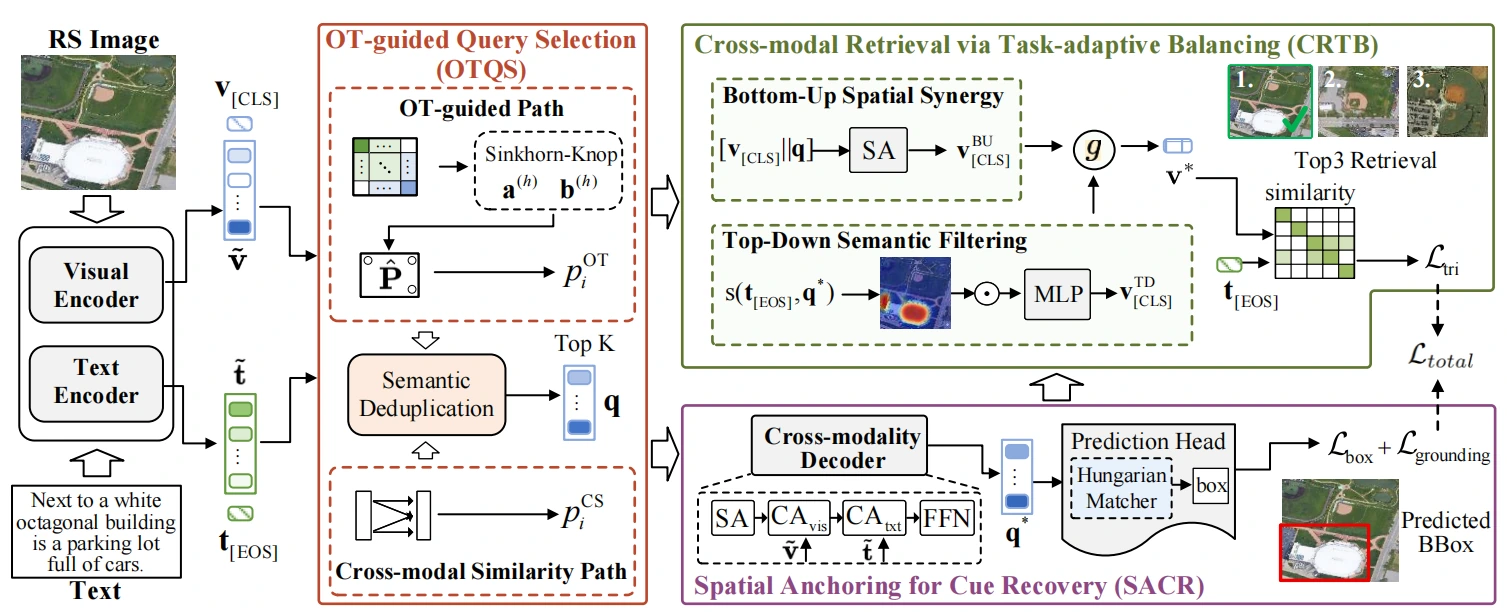
Explicit Spatial Localization and Task-Adaptive Balancing for Remote Sensing Image-Text Retrieval
A remote-sensing image–text retrieval framework that combines explicit object localization with adaptive coordination between spatial and semantic learning objectives.
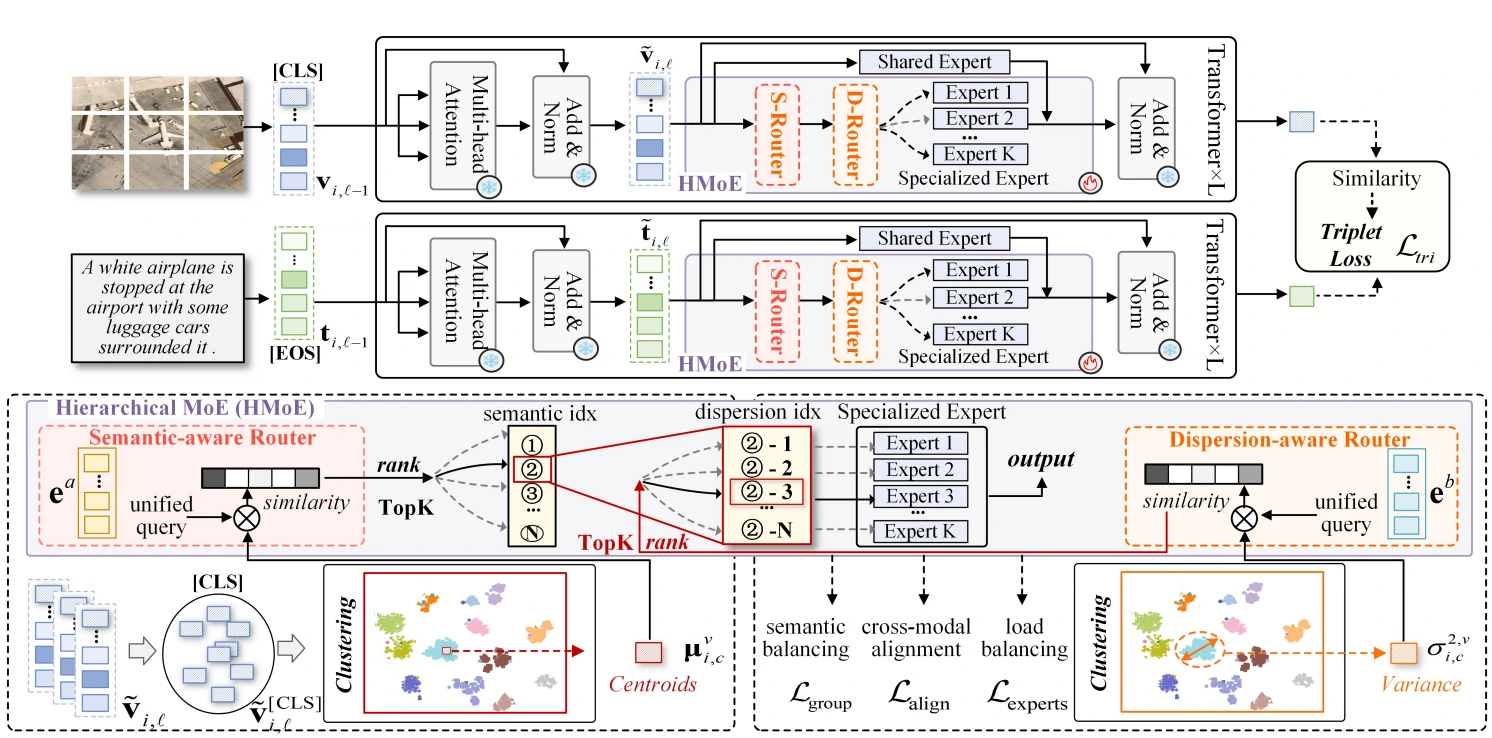
H-MoC: Hierarchical Mixture-of-Experts for Semantic- and Dispersion-Consistency in Remote Sensing Image-Text Retrieval
A hierarchical mixture-of-experts retrieval framework that promotes both semantic consistency and balanced feature dispersion across remote-sensing image and text representations.